
Watching Democracy’s Decline Tests United Methodist Faith
Opinion May 17, 2025

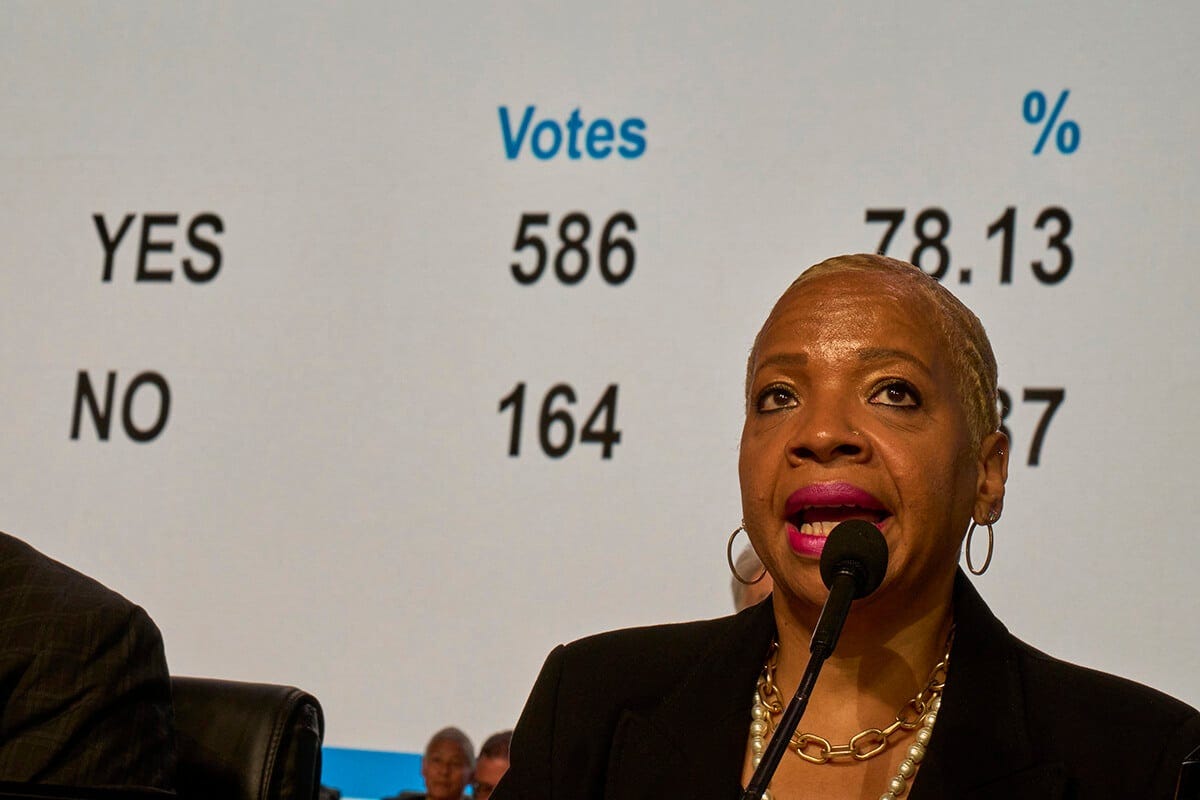
Bishop Tracy S. Malone surveys the results of a delegate vote in favor of a worldwide regionalization plan as she presides over a legislative session of the 2024 United Methodist General Conference in Charlotte, N.C., on April 25, 2024. The Council of Bishops announced Nov. 5, 2025 that annual conference lay and clergy voters ratified regionalization, creating eight co-equal geographic regions in place of a U.S.-centered denomination. (File photo by Paul Jeffrey/UM News)
By Cynthia B. Astle, Editor
No United Methodist who knows anything about the denomination’s history can feel anything but profound sadness at what’s happening to the American democratic republic. Good and bad, The United Methodist Church and its predecessors have shaped and been shaped by the United States of America since before its founding as a nation, so there’s a deep emotional parallel between the two institutions.
Sad to say, many individual United Methodists have contributed to democracy’s decline even as the UMC struggles to live into its new structure and updated beliefs. The denomination’s new identity puts it diametrically opposed to most of the policies and actions of the current US administration, and for some that’s going too far.
The contrasts are sharp.
Where the USA pursues “America First,” the UMC has restructured itself into eight co-equal international governance regions. Much remains to be reshaped and removed as the denomination frees itself from US domination. The recent denomination-wide survey paints the challenge clearly, as its responses came mostly from American Methodists with computer access, so the results are still shaped predominantly by US worldviews.
Where the USA persecutes immigrants and people of color, the UMC has integrated anti-racism into its psyche for the past six years. The Council of Bishops recently tackled the UMC’s racist history as it examined the creation and revocation of the racially segregated Central Jurisdiction. Sixty years after the UMC’s founding, equality still hasn’t reached some white-majority churches that won’t accept a Black pastor.
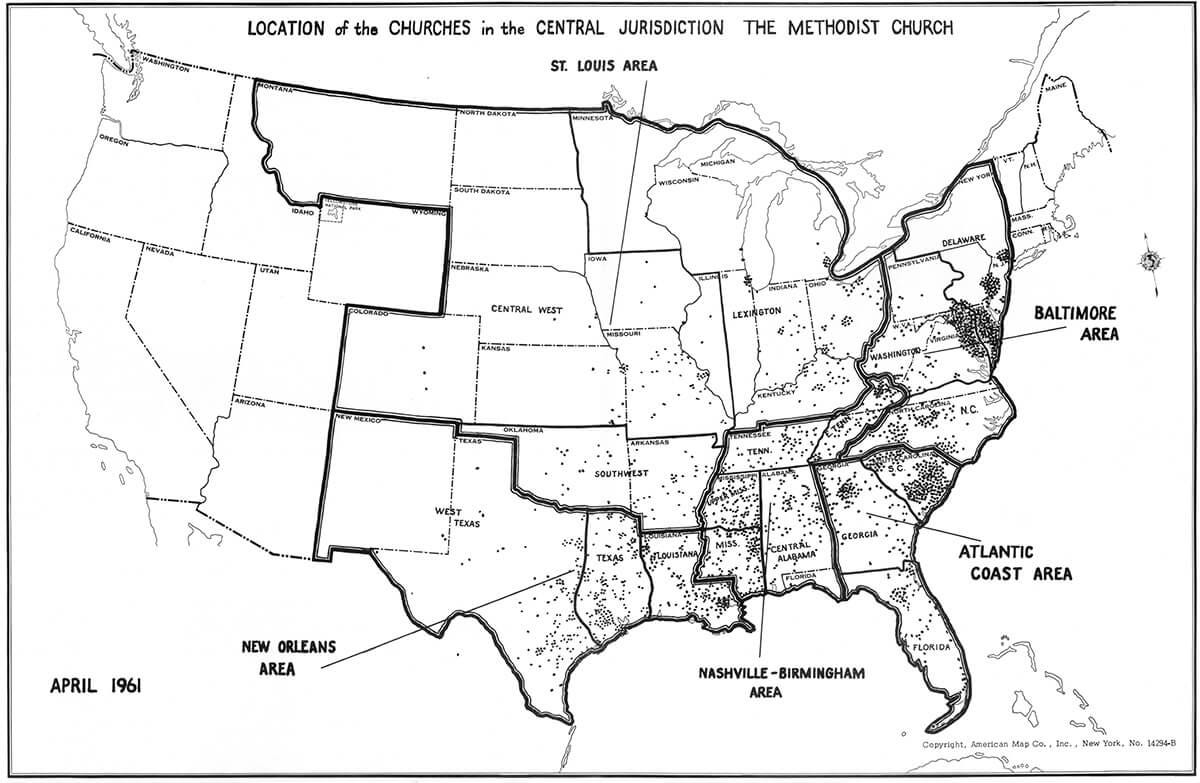
A 1961 map shows the location of churches and the borders of episcopal areas within the Central Jurisdiction, which the Methodist Church established to segregate Black members from the wider church. The union that formed The United Methodist Church in 1968 dissolved the Central Jurisdiction. During the Council of Bishops spring meeting in Jacksonville, Fla., bishops explored the legacy of the Central Jurisdiction as denominational leaders consider changes to the geographic jurisdictional system. (Image courtesy of General Commission on Archives and History)
The US Supreme Court has gutted the 1965 Voting Rights Act, and the Republican Party is frantically redrawing voting districts to split up Black regions and preserve its political power. Meanwhile the UMC’s leaders are seeking ways to assure that delegates from all its international regions can be present to vote at the 2028 General Conference in Minneapolis, Minn., even as the current federal administration tightens travel restrictions.
While these and more dissonances occur between church and society, there’s discussion, debate and dismay that the UMC has “lost its way.” But what was that “way?”
In many respects, American Methodism bears as much responsibility for current political and social upheavals as any other institution. From the first, Methodism in America was marred by racism. The Christmas Conference in 1784 elevated Francis Asbury as bishop, but refused to ordain Harry Hosier, Asbury’s traveling companion and the extraordinary Black evangelist who brought hundreds to Christ. In 1816, St. George’s Methodist Episcopal Church in Philadelphia pulled Black Methodists off their knees when they tried to receive Holy Communion with white parishioners, leading Richard Allen and others to depart and form the African Methodist Episcopal Church. In 1844, the Methodist Church split into northern and southern branches because a white bishop who owned slaves wouldn’t give them up.
In 1939, when three Methodist branches sought to merge, the southern branch would only agree if the church institutionalized racism in the segregated Central Jurisdiction. While the Central Jurisdiction provided social cohesion for Black Methodists in the Jim Crow era, the division gave white Methodists sanction to resist the Civil Rights Movement from the 1940s onward. As the Rev. John Elford put it in his book, our hearts were “strangely lukewarm” as white Methodist churches rejected racial equality even when a white bishop and a Black bishop prayed together outside a Mississippi sanctuary.
Perhaps the most shocking development came in the 2024 presidential election, when surveys found that 60 percent of voters who identified as Methodist voted for Donald Trump. Since then, the Trump administration has been dismantling the rule of law that until now protected the rights of Americans of all races, colors and creeds, including freedom of religion.
Facing this history, lamentation and skepticism over the UMC “losing its way” may represent the last gasp of the denomination’s shameful past of imperial collusion. The organizational changes made thus far only scratch the surface of what’s needed for the UMC to be genuinely the church of Jesus Christ amid a crumbling American empire.
Change frightens. It’s hard to see reasons for loving boldly, serving joyfully and leading courageously, to paraphrase the UMC’s new vision statement, when everything the denomination now officially endorses contradicts the will of those in political power. The same situation existed when Jesus walked the earth, and one suspects many United Methodists secretly fear they too will be sacrificed as Jesus was if they adhere to his teachings. Even the courageous witness of United Methodists who’ve defended their immigrant neighbors against “enforcement” hasn’t been enough to convince some church members to give up their Americanized religion focused on “what’s in it for me?”
Consequently, The United Methodist Church likely will continue to lose members in the United States; if so, that part of its worldwide denomination won’t be supportable much longer. It’s plausible that significant collapse could occur if the new UMC in the United States genuinely offers an alternative other-focused collaborative lifestyle opposed to a self-centered, corrupted materialistic culture.
Many United Methodists have trouble seeing beyond such a frightening scenario. Yet the choice is clear: the UMC must lose its former life to find the new life that awaits. It’s now experiencing repentance on the way to redemption; the path is murky, with only enough light for the next step. Its new life will depend not on top-level gatherings and catchy slogans but on changed hearts in neighborhood churches where people need compassion, care and hope in tough times.
John Wesley’s method for such mission pursued not institutional credibility but personal piety and social holiness. Perhaps that’s “the way” United Methodism should seek once again.
Cynthia B. Astle serves as Editor of United Methodist Insight, which she founded in 2011 as a media platform to amplify the voices of marginalized and under-served United Methodists.